
Sources over slogans
Follow the influence.
How did a decades-long network of institutions, funding, legal strategy, media, organizing, data and personnel become governing capacity? This project maps the documented pathways — and labels what the evidence still cannot prove.
The big picture
How the machine was built.
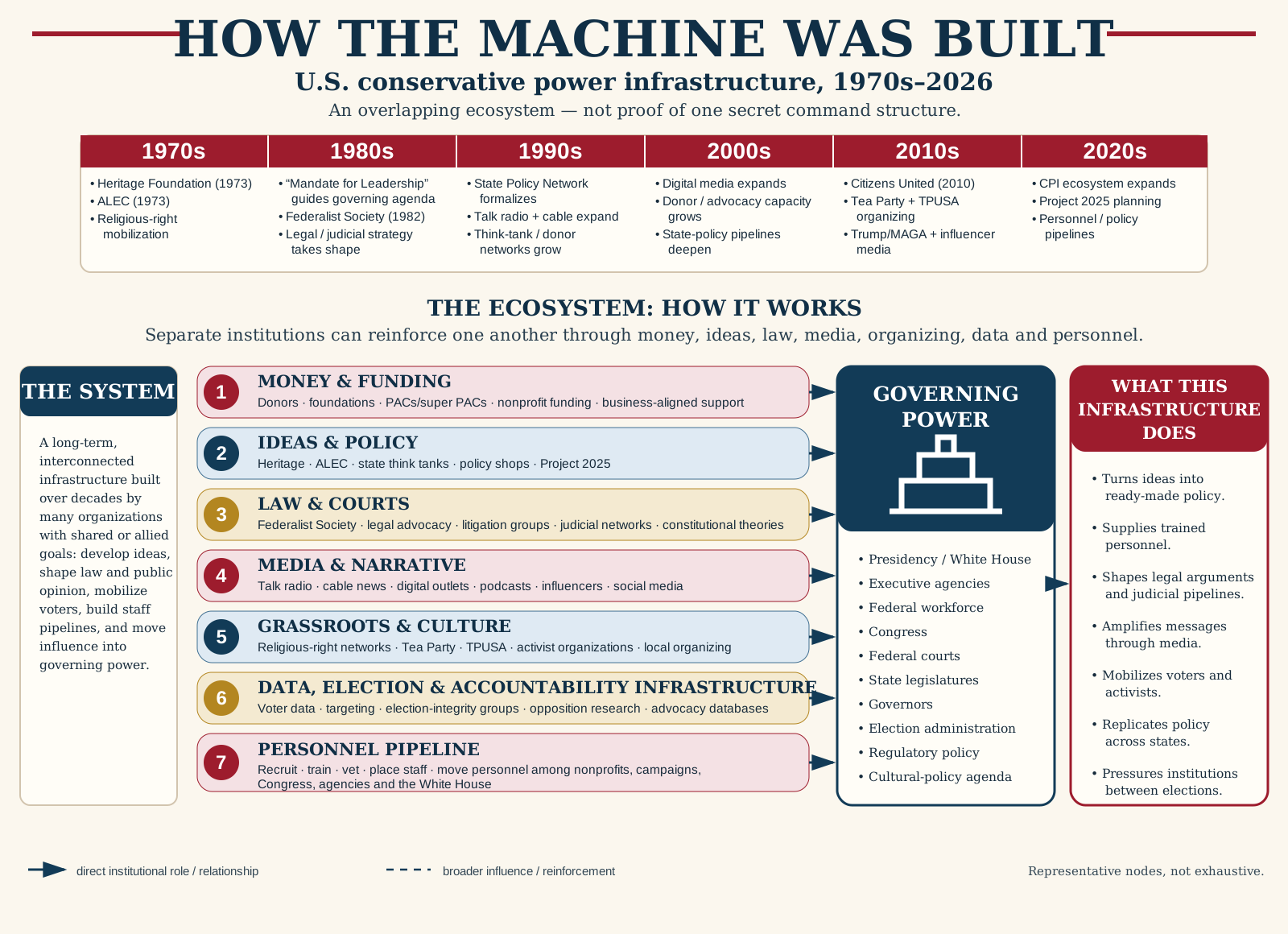
This is the overview our research is organized around: a long-term infrastructure that developed outside government and increasingly supplied ideas, legal theories, communications capacity, voter/data systems and personnel to governing institutions.
How to read it
The strings are not all the same.
A shared office, staff member, donor, policy goal or public appearance can matter — but each means something different. The project separates direct evidence from interpretation.
Direct evidence
Primary records, official statements, filings, financial records or strong independent reporting establish the relationship.
Evidence points there
Several documented facts support the interpretation, but the final link is not directly established.
Still unresolved
The gap matters and is worth pursuing, but the answer is not yet known.
Claims conflict
Material assertions are contested or incomplete, so competing accounts remain visible.
The working thesis
Build capacity out of power. Use it when power returns.
The recurring pattern we are testing is: build institutions → develop ideas and legal theories → recruit/train personnel → assemble communications and data capacity → gain access to government → implement.
Infrastructure
Organizations make ideas executable.
Think tanks, legal groups, staffing networks, training programs and administrative support can turn political preferences into ready-to-use governing capacity.
Movement
People carry knowledge between nodes.
Appointments, board roles, staff movement and recurring personnel show how policy knowledge and operational experience travel.
Outcome
Then ask who benefits.
The map is incomplete until it connects institutional change to consequences for representation, liberty, economic security and accountability.
Go deeper than the overview.
The Research page breaks the map into branches. The Sources page shows the evidence standard and the records used to support those connections.